cloudflare/cobweb: COBOL to WebAssembly compiler
cloudflare/cobweb: COBOL to WebAssembly compiler - I'll just leave this here. Let someone else clean up the old stuff. what else can you say.
cloudflare/cobweb: COBOL to WebAssembly compiler - I'll just leave this here. Let someone else clean up the old stuff. what else can you say.
Pyodide is a bit of a lifesaver for me in bDS: I must admit, I'm not really super deep into TypeScript and I actually don't feel like writing it myself. If the AI does it, that's okay, there's enough knowledge for an LLM to draw on, but I don't really want to delve deep into it myself. And Python has been one of my favorite languages for a long time. And Pyodide offers exactly that: a port of CPython to WebAssembly. It provides a pleasant language for scripts and macros that can access everything the application does and - if I ever want to - can also load Python libraries.
Drizzle ORM - was suggested by AI during the construction of bDS and has proven to be very reliable. A clean ORM for TypeScript with a quite nice API that strongly reminds me of Django. Additionally, clean mapping of migrations, which then simply allow SQL, thus enabling more complex migrations. And so far completely unobtrusive in operation. What is particularly interesting: there is a direct translation to GraphQL, so that the objects can also be exposed to an API, which I think I should take a look at (or rather, I should complain to the AI that it should take a look at it). I am always a fan of flexible standard integrations to connect external tools.
A2UI is an interesting project for a streaming-oriented protocol for applications with LLM integration. The basic idea is streaming JSON snippets from which the UI is then incrementally built, and the LLM controls what goes into the UI. It allows the LLM to produce more than just simple textual descriptions or basic ASCII graphics and also gives LLM queries a different look. The whole thing comes from Google and is maintained on an open github project. In bDS, I have also integrated it, and it's quite something when you can get a heatmap of the distribution of your blog posts across the months.
Waggle Dance . oldie, but goldie. Always fun how this rather simple game can captivate people, even over 10 years after its release.
OpenCode | The Open-Source AI Coding Agent - an open-source coding agent that could soon outperform Claude Code. Very good in execution and above all provider-agnostic. You can attach any model, even one self-hosted with LM Studio or ollama. If you just want to play around, you can simply download it and get started, even without providing a credit card (then of course with limited tokens, but quite usable for initial experiments. And independent of the major providers (ok, except for their models if you want to use them - and for serious coding, those are unfortunately still necessary). OpenCode also offers its own AI models, which are then billed, but a few models are always freely available and thus offer quite serious experimentation without investment.
Interesting interview with Steve Yegge (yes, that's right, Flamer-Steve who often stood out with very pointed to polemical comments). My favorite quote: "we are entering the John Deere era of programming" - yep, no longer the small farmer with a family business or the small cooperative, but the big wave with large code engines that will be created in masses. Also interesting is the point that code merging will become the bottleneck in the near future, because 10x productive programmers will also produce 10x more code and several of them will reorganize simultaneously because it just fits in between - ouch.
My own experiences with Vibe Coding: the software with which I now manage my blog is completely created this way. I am also building tools for SecondLife content via Vibe Coding. I use it at work for prototypes but also for complex desktop applications for more specific purposes. And this since December. I must say that I definitely feel that programming is on the verge of a upheaval comparable to the introduction of high-level languages (a bit before my time) or the introduction of runtimes with memory management (Java, DotNet, ...). Accordingly, it is quite loud with all the pro and contra voices. But it is definitely exciting. And the world will definitely change for programmers.
Now the new software is starting to be fun, everything you need for usage and creation is largely present. It still has a few minor flaws and there are one or two features I want, but I can already do everything I really need as a minimum. Publishing now works easily with a shell script:
#!/bin/sh

cd ~/Blogs/rfc1437.de/html

rsync -rav --delete \
	--exclude='thumbnails/' \
	--exclude='media/' \
	* git.rfc1437.de:git-server/html/

cd ..

rsync -rav --delete thumbnails/ git.rfc1437.de:git-server/html/thumbnails/
rsync -rav --exclude='*.meta' --delete media/ git.rfc1437.de:git-server/html/media/
Yes, that was just to test my source formatting. And?
Big Damn Stupid - no, Blogging Desktop Server. Currently my favorite project where I play around with Vibe-Coding and build software with which I can run the blog. But this time with the clear perspective that I won't succumb to bit rot or the complexity spiral again. Simple software with a usable interface for maintaining blog posts, but storage as Markdown files with YAML front matter to be easily stable for the future. Then with sqlite for caching and full-text search and other comfort features and git for synchronizing the blog data, and git-lfs for the images. Feels quite usable right now.
Schotten Totten 2 is becoming one of our favorite two-player games. A remake of the old Schotten Totten (which unfortunately is no longer available under that name, only as Battle Line, but that only in English). Unlike the first game, now asymmetric with just enough difference in gameplay that the two sides definitely feel different, but still mostly doing the same things. Quick to set up, quick to play, and quick to put away with enough tactics to keep you hooked for a few games. And the graphic style is just nice.
Tak is quite an interesting game: inspired by a fantasy novel by Patrick Rothfuss, brought to life as a fictional "classic" strategy game. The beauty of it: you can easily make it yourself if you want and are skilled. The rules are super simple and easy to learn, but the game is tricky with many opportunities to set traps for the opponent. It will probably be taken for our next vacation because it's practical to play outdoors.
Because Google Authenticator annoys me: In-depth tutorial: How to set up 2FA TOTP with KeepassXC, Aegis and Authy. | Linux.org. Keepassxc is much nicer, in my opinion, and is much more controllable for me.
... and of course, the surround sound of my notebook no longer works, for reasons. And fingerprint login makes a lot less sense when you have to enter the password for the keyring after login anyway. If it at least came up for the first time when a password was needed, that would be okay, but it comes up directly after login. Bah.
Otherwise, however, I am pleasantly surprised at how good the Linux support for the Lenovo T480 is. Everything else has been working flawlessly so far.
Prime Time for Prime Slime is the second of my "reinventing the past" deck lists. It is actually my first commander precon deck - Mimeoplasm - just spiced up to 11. It kinda is funny how I stuck with the theme of the deck, transitioning it from the precon to Ooze tribal and later reanimator, then turned it into Muldrotha combo and again turned it back to Mimeoplasm, when the Prime Slime secret lair came out (I love the art style), going full on Necrotic Ooze combo this time. It is a ton of fun to play, which is why some of the old stuff from my collection made it's way into that deck. #EDH #MtG #MagicTheGathering
Kaalia of the Blast is one of my "lets recreate original commander" decks. The idea is to keep close to the original structure - one commander with the focus of the deck, a supporting commander that could become the main with some changes, and a big dragon in the same colors. And have the game plan of one of the originals, too. So in a way an updated Kaalia with a bit more focus and dedication, but still Angel/Dragon/Demon beatdown. #EDH #MtG
Abdel, Agent of the Iron Throne is my latest high-power, near-competitive creation. The deck has a very linear combo plan with a lot of redundancy in the parts, and above all both combo element and combo payoff in the command zone. What is lacking in interaction due to the colors is replaced by resilience. I like linear combo because it gives the game a clear plan and, for example, makes mulligan decisions much easier.
Dargo for the Lulz is a deck that has positively surprised me with how strong it is. I would place it in a similar category as Godo, so definitely cEDH viable. Although the combo is not the commander alone, it only needs one more card (Phyrexian Altar) and it goes off if there are a few Treasures lying around or creatures to sacrifice. And the Plan B with Beatdown also works well.
Well, we found a solution. And it went really well - 6 players were involved, each at home. I had the game and a camera setup to put the image on the internet - and then deliver it to everyone at home with Microsoft Teams. Then headsets and off we went, explaining the game, playing, talking about it together - all of this is also possible during times of social distancing.
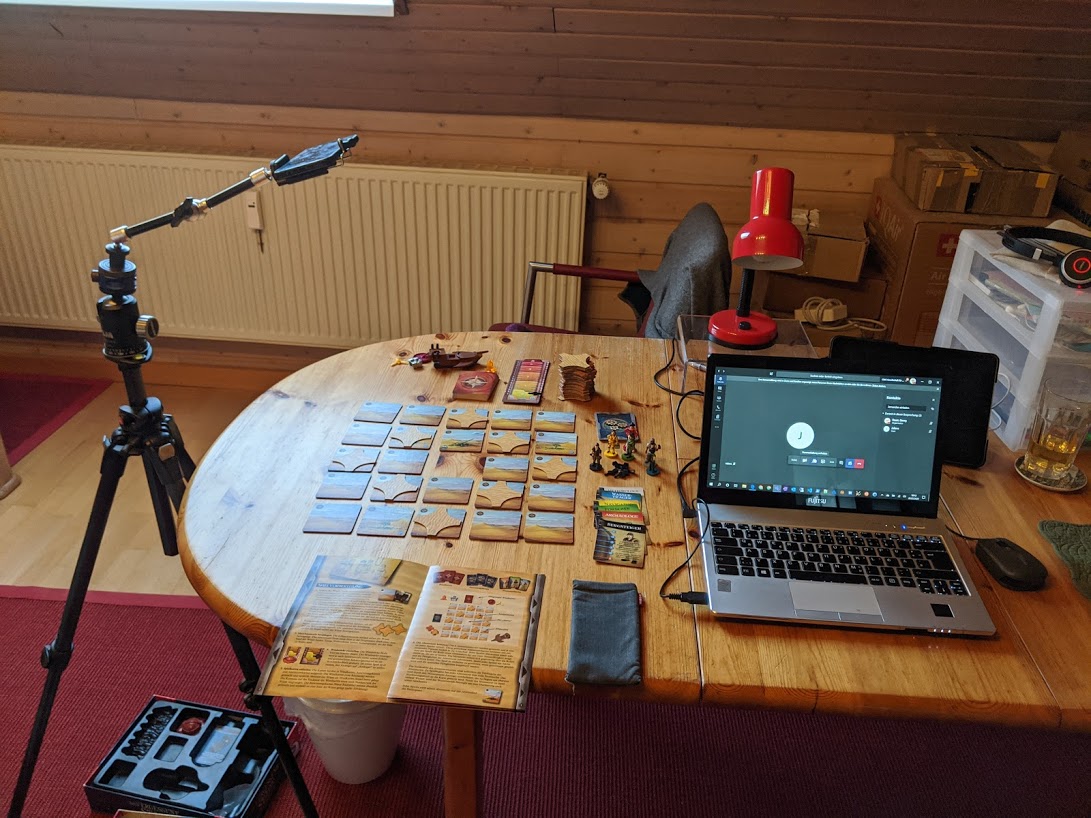
I already had the camera tripod, the small swivel arm with phone holder costs 35€ and the phone - you often already have something like that. Then on the phone a small app - "IP Webcam" - with which the phone's camera is accessible via a website. And on the notebook Teams, with which I shared the browser window with all participants. And off we go!
Jhoira, Scrap That! is now my primary deck for cEDH and it has proven to be damn good so far. The deck actually always has a line, can react to almost everything and has good rebuild capabilities. Through multiple overlapping combos, it offers flexible ways to win even through Stax or Hate. And even if I don't win: the deck definitely leaves a lasting impression on the opponents.
Rurik: Dawn of Kiev is a Kickstarter game that arrived at my place a few weeks ago and has since been on the table a few times. Interesting aspects of the game are the action selection with differently rated advisors in a separate auction phase, in which you select the action possibilities and a bit the order in which you execute them, but how strong the action will be depends on the fellow players. The actions are only evaluated in the second phase, where you then have to see how to cope with what you get. The target scores are very close to each other, every point counts. Also very nice game material and a practical sorting insert.
Bears on a Plane is my attempt to build an effective Prison deck in cEDH. First attempts with the deck were accordingly "disgusting". Can only be tested sporadically due to Anger-Management-Issues of the Playgroup ...
Tin Elves - Tin Elves. My last artifact combo deck for Magic the Gathering. Felt super solid in the last game. The deck goes hard on artifact combos, but uses a number of elements that also work super well for an aggro strategy. If my combo pieces get shot down, I just attack with a horde of Thopters. And Emry as Commander helps me get around the Commander tax because her Affinity-to-Artifacts ability is worth its weight in gold in this deck - and since she's also a combo piece, the deck has very good chances of coming back from behind. I'll probably still stabilize the list a bit, but the composition seems to be a real hit. Probably going to Bologna with it.
Wingspan is my new addition from Essen this year (not the only one, but the one I've played so far) and I'm very happy to have bought the game. A tableau builder with cards, where the cards improve the action possibilities - that's already perfect for me. Variable setup, secret objectives and high combo potential in the cards make it even better. And the first games with 2 and 5 players were super exciting. The game offers a nice escalation curve in the game - the rounds have fewer and fewer actions, but the actions themselves get better and better. And when you hit a productive combo, it just feels good. Add to that good quality materials and appealing graphics, this is a slam-dunk for me.
Golos is on a pilgrimage to find the most efficient combos to run in his deck - and I am helping him to achieve his goal. My last decklist, which I am working on. It's going pretty hard towards cEDH. The first games already felt really good, even though a bit of the explosive combo feeling was missing. But that might not be bad in my meta either, we play longer games. Therefore, the list is more focused on answers and less on T2 combo-win. But from what the list does, it fully goes in my preferred direction - not suicide combo, but first see what's possible, then strike when no one can answer enough.
Marvel Champions - Fantasy Flight Games Wow, this is unexpected. It looks very much like another offshoot of the LOTR system, albeit somewhat streamlined at first glance. But if it still achieves the gameplay depth of LOTR, that would be great. I do have a well-running Magic game round now, but for in-between, I always found LOTR quite exciting, as many game decisions (specifically the scenario-specific building of a deck) are very close to Magic.
Wow, Pauper Comes to Paper - with unified legality. Unfortunately, two of my favorite commons are banned: Hymn to Tourach and High Tide. Too bad. But still nice to finally have a unified legality for cards.
The London Mulligan will be the official mulligan in Magic starting with Core Set 2020. Great. We tried it in Commander and it was completely fine. And it was also good in Pauper. Of course, there are certainly a few decks that benefit excessively, but that can be regulated otherwise. The new mulligan simply helps to avoid "non-games" due to multiple bad starting hands. There's nothing more annoying than losing a game in the mulligan because every hand was without lands or only lands.
A Force to be Reckoned With - the new card "Force of Vigor" has just hit two of my decks hard. Jhoira as an artifact storm deck and Paradox Arcum as an artifact combo are both quite dependent on their artifacts and enchantments, such a card can just turn them off. Instant speed. For free. Ouch. If other lists go stronger on mana dorks instead of mana rocks, they have enough green cards to get FoV active. And then I'm out. Jhoira might still be able to hold on, but Storm usually has several vectors, but since artifacts only become instant-speed with Shimmer Myr (and it remains vulnerable as an artifact), Arcum is really hard hit.
May 20, 2019 Banned and Restricted Announcement - Wizards of the Coast just neutralized two of my decks for me - Izzet Blitz needs the free spells to pump its creatures or activate direct damage and Skred Delver needed them to fill the hand in the midgame. Ouch. Okay, lately I've mostly played Tron (or GB Tortex if I was in the mood for wild board states), but still, Skred Delver was always my favorite deck because of its explosive comebacks.
Alright folks, Metaowl has gone all digital today: there was this ancient WP installation running in the background, with various customizations. It was simply beyond saving, getting it to fly with newer PHP versions just takes too much time. I also don't think anyone will notice that the owl is no longer there. It was just a piece of internet history.
I like the new MTG Mulligan variant that is to be tested in London. Definitely, it must be seen whether this does not favor combos too much, but the current mana system and the structure of the current Mulligan simply lead to non-games too often, especially in my favorite format EDH. And it just feels stupid when you have to go down to 4 and still have a crappy hand, or then just scoop - and the others can discard their good starting hands because they would otherwise have a game with N-1 players, where one watches. Of course, in multiplayer, you can directly offer the other a further 7-card Mulligan, but the new variant would not make this necessary - I can always choose the best N cards from 7, so a 4-card Mulligan is bearable.
The Ninth World: A Skillbuilding Game for Numenera is a very strange game, essentially implementing the construction of an RPG character as a game. The character is guided in different directions by different cards, improves basic skills, finds special abilities, and experiences adventures. But everything is very strongly abstracted. For me, the game is carried mainly by the consistent graphics and the fact that setup and gameplay are relatively quick. Solid upper midfield, I would say. But quite usable for 30-60 minutes of time. But definitely not a must-have. And for me already symptomatic of Loneshark Games: the manual leaves much to be desired. It is not as incomplete as that of Apocrypha, but some things you really only see after multiple readings. More care and blind testing could have really helped.
Too Many Bones: Undertow has almost reached the top of my game list after just one playthrough. Essentially, it's an RPG in a box - choose a character, level up various stats, and each character has their own skill tree. Then there's the fact that each character plays completely differently. These characters are then tested in several scenarios with battles against a variety of opponents using a variation of the Hoplomachus combat system. Opponents and your own figures are represented by stacks of poker chips, abilities and actions by dice. Mountains of dice. But due to the many manipulation options, you're not hopelessly at the mercy of dice luck, but always retain a certain degree of control. And all of this is pure gaming fun, especially for me in solo play.
Ever wanted to try something really new and interesting? Petrichor might be just what you're looking for. Where else do players represent competing weather systems vying against each other to provide the best irrigation for crops? Very nice components, a very friendly designed game and an absolutely brutal feel. The cloud systems fight for dominance on the "map", argue about who determines the next weather and stop attacks from opposing cloud systems, all in the fight for points. It almost feels like a wargame. At first, it seems quite complex, as the effects of your own actions always influence several areas at the same time and you practically have to keep all the paths to victory points in mind to avoid falling behind. But after a few actions, you've got it and the game runs smoothly. Replay value is provided by the high variability of the setup.
Architects of the West Kingdom is my souvenir (one of several) from the Spiel 2018 in Essen. I like the graphic style of The Mico very much and the fact that Shem Phillips worked as a developer on it gave me hope. And the game delivers a very good picture. A very idiosyncratic look at worker placement combined with a dual goal path (virtuous cathedral building or thievish withholding and black market trading) provides a lot of fun, at least in our first game. Will definitely come to the table more often, it is not too complex in the actual game, the actions are not huge chains like in Viticulture, but usually directly connected to what you want to do next. Plus the missing blocking and the successive improvement of one's own actions, the capturing of the opponent's workers when they become too efficient, all very interesting action possibilities.
Recently, Iron Curtain has been played a lot at our place. It's almost like a Twilight Struggle as a microgame. 18 cards, a few wooden dice and off you go. Each card can be used for 1-4 (depending on the card) influence dice or for their event, generally it's about influence in countries and regions of the world. And it's impressive how much game depth has been packed into this small box and the little material. Definitely a lot of fun to play. The game is by the same creators as 13 Days, which we also really enjoyed.
Ethnos had been on my wishlist for a while, and I eventually bought it because I wanted a relatively easy-to-explain game for up to 6 players that I can play with any group. Not a long explanation, catchy gameplay (it reminds me a bit of Ticket to Ride, but here influence markers are placed in a country instead of trains on a map) and quick to play. Even with 6 players, we usually finish in one to one and a half hours. And it's really fun. Of course, due to the game concept, you are - just like in Ticket to Ride - strongly dependent on what you draw. But with tactical skill and attention, you can still wrestle a rough direction from chance. The different factions that appear in the game can be freely assembled from 6 out of 12, which can drastically change the game - having Halflings in the game feels completely different (suddenly everyone plays very large combat groups) than, for example, Centaurs (everyone wants some because you can play two or more combat groups). Elves and wizards keep your hands full, dwarves reduce the combat group sizes for points. Very fun and despite the variability, easy to explain.
Renegade is a game by Ricky Royal, one of my favorite board game YouTubers. He particularly enjoys showcasing solo games, and Renegade is an excellent solo game, naturally also playable as a cooperative game with multiple players. Cyberpunk theme, deck-building à la Mage Knight, but with a permanently size-limited deck (always 15 cards). The cards have a dual function (at least the cards you buy into the deck), either commands or events. And actually, buying is always worth it, as you buy directly to your hand, so you usually improve your hand. Additionally, a multi-stage game with intermediate goals that you can achieve for a bonus or ignore against a penalty. All this with a very lean area-control aspect. I really like it.
One Deck Dungeon: Forest of Shadows is another solo game. Okay, you can also play it cooperatively with two players, but somehow it still feels more solo-focused to me. A classic rogue-like, but as a card and dice game. As in the old computer games, you are a single (or two) fighter of different classes who must fight their way through a dungeon, three levels deep, to then face the final boss. Along the way, you defeat monsters and trials and receive abilities, items, or potions in return. In the end, these are of course just more dice and dice manipulations, but thematically it all works surprisingly well and is - despite the manageable number of cards - surprisingly varied.
In my constant search for interesting solitaire games, I recently stumbled upon Wars of Marcus Aurelius: Rome 170-180CE. Hollandspiele is a small but fine wargame publisher that has released a whole series of challenging solitaire games. And with the Wars of Marcus Aurelius, they have, in my opinion, hit a real jackpot: a mix of State of Siege and CDG. State of Siege is characterized by the different fronts that push towards a center and constantly threaten to overwhelm the player. This element is also present here. But while in State of Siege the dice dominate and cards only provide a historical framework, here the cards are absolutely central. The classic CDG mechanism allows cards to be used for ordinary actions or for the printed event. Generally, there are several uses for cards and the player can manage their hand of cards over the seasons of the current year, always considering whether to use or save the cards. Add to this the opponent driven by card effects. Dice are only used to determine conflict victories and there are many ways to influence the dice result. Overall, a really good mix, which, however, comes across as quite challenging, as one quickly loses in the spring of the second year ...
Fields of Green is essentially a reworking of Among the Stars - the same card drafting, the same tableau building, and again the dependencies of the card arrangement for victory points (and there are the same three types of cards with immediate effect, round effect, and end-of-game scoring). But instead of space stations in outer space, here it's all about the fields and the dear livestock. A game vacation on the farm, so to speak. All in a nice package with very clear rules and round sequences and a few new tricks compared to the predecessor game. Unfortunately, just like the predecessor game, it's only for 4 players, but a 5-player expansion is already on the way. For larger groups, however, 7 Wonders remains unbeaten as a drafting game.
I finally got Innovation on the table at the weekly game meetup and must say, I like it. I had only played with a fan-made solo rule before, but with multiple players, a highly interactive game like this is simply better. Exploiting card combos doesn't work as well in solo play, so many interactions fall by the wayside. The game offers a lot of combos and an interesting flow through participating in other players' cooperative dogmas (card effects) and the way affected players are chosen in imperative dogmas. Definitely fun for more, although the game is really very text-heavy and probably only truly great when the games have been played multiple times and know what cards are in play.
'Kernel memory leaking' Intel processor design flaw forces Linux, Windows redesign • The Register - and all Intel-based systems will be slower. 5-30% performance loss depending on the specific workload on the systems. Ouch.
After we had already played the picture version a lot, Codenames Duet came into our collection - a two-person version of Codenames. And it's really fun, though for us only in a picture version. We both found it extremely stressful and unsatisfying with the words, but with the pictures from Codename Pictures it really brings joy. And since it's cooperative, you can quickly take it out when we don't feel like fighting.
Juliana's new favorite game: Battle Line. A classic, in our case with a new graphic design featuring knights instead of hoplites. 9 columns where you play a small "poker" game, the higher combo wins. The goal is to win 3 adjacent territories or a total of 5 territories. Easy to learn, easy to play (we don't play the expansion with tactic cards as it's only available in English). Within a very short time, the game has been played over 100 times and even more by Juliana, because it's the first game she voluntarily unpacks and plays by herself (left hand against right hand). Something that has never happened before. So definitely a quality statement for the game.
Another new addition is Viticulture Essential Edition - purchased on the occasion of a 10-euro voucher from the local game store, chosen because of the number of players (1-6). So far, I have only played it solo, but it works excellently for that. And from what I've seen, I'm already looking forward to playing it in the player round - a well-intermeshed worker placement, where the theme fits quite well with the actions in the game (ok, some details are a bit "creative", but overall the interplay of the actions makes sense). The whole thing then with quite challenging decisions in the game, but not as far as, for example, in Gallerist or similar highly complex games. So really something for the weekly round and not immediately a time investment for the weekend.
Recently, Godforsaken Scavengers arrived from Kickstarter and I tried it out right away. Originally, I only grabbed it because the unusual theme (or rather the style) appealed to me. It's basically a dungeon crawl with character attributes, events, locations, and everything that goes with it, packed into a super compact playtime and wrapped in appealing graphics. So, absolutely great for a quick game, as it hardly consumes any setup and the game itself is quick to finish. It has exactly the right length for the high proportion of luck it takes to survive - if things go wrong, not much time is invested, just shuffle and go again.
Another trade show souvenir is Azul, a nice tile-laying game with a super-friendly (and super-painted) theme: tile laying. The game itself is quite competitive and a lot of fun (at least for me) and has been well received in the board game group so far. I particularly like the short playing time, many games in our collection go beyond the hour and this one can be easily finished in 40 minutes, even with 4 players. In addition, it is super easy to teach to the players and the material is simply great. This will certainly find its way onto the table more often.
Triplock is a new addition that surprised me - I only picked it up because the manufacturer often delivers very interesting games in superb quality and the theme appealed to me (Steampunk world and lock picking). What surprised me, however, was how much I enjoyed it. Essentially, it's a classic memory game - uncovering combinations, remembering the same, swapping and twisting, and at the same time keeping an overview of what is where. A bit like the typical shell game, only as a board game with a story. And it works damn well, also (or perhaps even especially) solo. You happily play several rounds in a row until you've cracked the current scenario.