Here's what I found worth reading over the course of the week and didn't want to link separately, collected and uncommented.
Archive 24.1.2016 - 11.9.2016
Here are some interesting reads from this week that I didn't want to link to separately, collected here without comments.
7 Wonders Juliana and I usually play in the Duell version. But since our Thursday round is growing, we also got the big game - with the Cities expansion you can play with up to 8 players. Today was the first training session with the 2-player variant included in the box. Definitely more cumbersome than the small duel, but equally definitely noticeable how the game can run with larger rounds - and it's fun for more. Just enough interactivity not to turn into a multiplayer solitaire, but enough strategy not to become a pure random number. I like it very much.
Here are some interesting reads from this week that I didn't want to link to separately, collected here without comments:
Here are some interesting reads from this week that I didn't want to link to separately, collected here without comments:
Whenever I look at EDH decks, I actually want to build something crazy that has massive combo potential and relatively high stability against various other decks. Slobad - Self-Mill/Eggs (Competitive) (Commander / EDH MTG Deck) does exactly that, if I interpret the list correctly. It's amazing how a rather "cozy" general can be bred into a combo monster.
Here are some articles I found worth reading this week, collected and uncommented:
Yesterday I played Deckmaster: A MTG Variant Format by Jim Bowie again - and this time, as often recently, against the Horde (the solo variant for MTG). Pretty cool, slowly my Main Stack is becoming quite usable for this. Still some fine-tuning needed, but it's getting there. The special thing this time: out of the three games I played, I basically played three different archetypes. In the first game, a classic lifegain deck, where I almost didn't care how many Minotaurs attacked me, as I kept coming back up through lifegain and could block with smaller creatures and attack with a few boosted creatures. In the second game, one of the funniest deck variants: Voltron. But not just any creature, but a 0/4 Ox from Theros. With the Vows of Wildness on it, a 3/7 for power-blocking large Minotaurs from the Horde and with the Firewhips then double strike after Titan's Strength as a 6/8. It went through the Horde like butter. But the coolest round was the third one: no creatures appeared, only removal and board wipes. The result was a classic control deck with which I could clear the Minotaurs right at the start. My deck still went down to only 4 points, but then it stabilized and in the meantime a finisher appeared with the Stalker from the sixth district. The Stalker gets a boost for every creature in the opponent's graveyard - and the Minotaurs have a lot there after a while. Which led to the Stalker, thanks to removals, simply clearing the Horde deck with 20-point hits. Cool.
Here's what I found worth reading this week, collected and uncommented:
Without Fear and Nobility is practically an oldie, but it was new for Juliana and me. I mainly got it to have something small for larger rounds, as our weekly board game evening is slowly growing. We have only played it in pairs so far, but even then the game is very nice. It reminds a bit of San Juan, with the buildings primarily serving as a source of money (and points), the violet buildings with special functions and the role selection. Very interactive and at least with two players even with strategic elements, which, however, in larger rounds are probably displaced in favor of purely tactical play. But it's definitely fun.
Yomi Starter Set: Grave versus Jaina is a very unusual and interesting game for me, which brings some problems in solo play. Yomi simulates the old 2D Fighter Games - classic Punch/Throw/Block actions in a Rock/Paper/Scissors configuration. But all of this as a card game with simultaneous playing of action cards. Which basically comes down to guessing the opponent's actions. Which doesn't work so well in solo play - due to the lack of a guessable opponent. So it's only the evaluation of your own hand of cards, a bit of statistics and card counting. Which is surprisingly interesting against an automaton that blindly draws from the deck. You wouldn't expect it, but the cards offer enough interesting combination possibilities that it remains interesting anyway. At least for learning the different characters, it is usable, whether it can also offer long-term fun remains to be seen. As I said, this only refers to solo play, with a real opponent it will certainly be different.
What I consider worth reading over the course of the week and did not want to link separately, collected here and uncommented.
What I considered worth reading during the week and did not want to link separately, collected here and uncommented.
What I considered worth reading during the week and did not want to link separately, collected here and uncommented.
Leaving Earth is a game in which players manage a space agency and must carry out missions. The solo version presents some exciting challenges, as you need to win at least half of the mission points available. This is already quite difficult - in my first game, to even have a chance of winning solo, I first had to examine Venus to find out that you can't land there (which allowed me to discard the Venus missions and thus reduce the point load) and then carry out a manned Mars mission. The latter failed due to lack of time and propulsion equipment. But ideas are already circulating on how to make the whole thing run better next time. And that's a good sign for a hard optimization game - here you don't shoot or send old men with atomic bombs to asteroids, here you plan your budget, your multi-year missions, and the risk you want to take. Cool. For Science!
Here are some interesting reads from this week that I didn't want to link to separately, collected here without comment.
- “Horum omnium fortissimi sunt Belgae.” – AAR for 2nd Play of Falling Sky: The Gallic Revolt Against Caesar by GMT Games
- Rome Didn’t Dominate You in a Day
- “One Square Mile of Hell” – A Preview of D-Day at Tarawa by Decision Games
- Konan’s Set 7.0 Metagame Analysis
- Delian League Diaries #6
- A Preview of Falling Sky: The Gallic Revolt Against Caesar Volume VI of the COIN Series by GMT Games
- Die gefaltete Welt des Erwin Hapke
- 2016-06-06 19:23:00
- Delian League Diaries #5
- The Madness Behind a CDG Solo Method
1775: Rebellion hit the table for the second time today and was another great success: a draw, both sides controlled 5 colonies, and North America became a southern province of French Canada. The best of all possible outcomes when you look at today's presidential candidates. I really like the game - the strategies must really be balanced, if you want to hold the southern colonies, you also have to defend them, at the same time you don't want to lose the northern ones, because there are many colonies there. England is vulnerable because two hard-to-defend colonies lie far in the north, which the Americans can invade. I was two colonies ahead when I started the last round, but then I lost two colonies - and possibly Juliana could have even attacked three. Juliana also likes it, so it will definitely hit the table again.
Night of Man is a tactical combat game, Aliens vs Humans (or other Aliens). So far, my favorite game in the niche has been Hoplomachus, as it captures gladiatorial combat, which is its theme, quite well. And because it has solid solo rules. Night of Man complements my collection with more extended combat, also with solo rules. However, the rules themselves are also the biggest drawback - they are quite well written, but during the game, gaps and weaknesses become apparent, symbols without explanation, or situations that are not clarified. More careful development of the game would certainly have helped here. But if you use common sense, you can solve most things yourself. The game itself is very entertaining. The impulses go quickly, the game does not stall for long, as you usually only activate a few units (often only one). This way, both sides have something to do, and the reaction cards provide even more interaction. Definitely makes you want more, especially with the solo rules (so far it was left hand against right hand). And the components are well made, and especially the counters are very old-man-eye-friendly.
I don't really play MTG anymore (except online), but EDH is still my favorite format and I always check out interesting decks. Reinventing The Commander 2015 “Seize Control” Pre-Con, Part 2: It Seemed So Innocent… provides an interesting perspective on an Izzet deck focused on non-creatures. It really looks fun and is not the typical Mizzix or Melek Wahl. And it provides an interesting theme for the color combination that doesn't necessarily have to be based in Ravnica.
The Gallerist Review – A Masterpiece – Wolf's Gaming Blog is a good review of one of my favorite heavy games. This reminds me that I should definitely take the box out of the closet again.
Dawn of the Zeds (Third edition) is one of the Kickstarter deliveries I've been eagerly anticipating this year, which finally arrived a few days ago. The anticipation came from the fact that it's from one of my favorite publishers - Victory Point Games - who have ventured into mass-market production with this one. No more print-on-demand with laser-cut components, but professional production in high quality was the goal. Add to that the fact that Dawn of the Zeds is the pinnacle of the States of Siege series. Essentially tower defense with control of events and enemy attacks through a configurable deck of cards. The result? Wow. Simply wow. The components are absolutely top-notch, the entire material looks fantastic. The modular game system allows for different difficulty levels, both for cooperative play and for one-against-many. Plus, there's a No-Brains mode, which essentially offers an extremely simplified system for beer-and-chips evenings. The game is most comparable to a zombie movie, the story is built up excitingly and the prepared decks of cards keep the tension high. Absolutely fantastic gaming experience. The setup is a bit cumbersome, as all the elements need to be prepared, but it's within the acceptable range for such a game. This will definitely hit the table more often, as even in solo play, the whole thing is extremely fun.
UBports could potentially breathe new life into my old Nexus 5 when purchasing my next Nexus, which would be more than what was possible with my old Galaxy Nexus.
Simmons Games: Napoleon’s Triumph Sample Game shows well why I am looking for an affordable copy of this game. The graphic design is simply brilliant, the game system relatively compact and unusual, the whole thing looks more like one of the old military planning games than a classic wargame. Many possible ways the conflict can develop, depending on how the players decide. Simply all-around well made.
I am particularly fascinated by games with a scientific background. That's why Greenland was an obvious choice for me. The author Phil Eklund is known for his very intensive study of the themes of his games. This is also the case here - the struggle for survival of the Thule, Tunit and Norwegians in Greenland around the year 1000 is thematically addressed, especially the changes brought about by the Little Ice Age and the resulting changes in life and migrations. The result is a remarkably dense game with a lot of strategy and tactics. The rules are somewhat very compactly structured, but can be mastered with a bit of reading - or simply watch a few of the videos on the game page at BGG. In principle, not really much new in terms of techniques and mechanics - worker placement with dice decisions about success, resource management and an event engine that builds up the necessary pressure. The solo variant is solid and can be well adapted to your own requirements. Multiplayer I unfortunately haven't been able to try out yet, as the game is only available in English. But for solo, a clear recommendation.
1775: Rebellion is a game about the American Revolutionary War. Solidly situated in the War-Euro area with surprisingly compact rules. But not just Risk-with-theme, but quite strategic. I particularly like the very compact game situation with only 12 cards per faction - in the 4-player mode, it's played 2 vs. 2, with two players each playing two factions. Due to the small number of rules and cards, even the first game plays relatively quickly and you quickly recognize the strategic and tactical possibilities. And despite its compactness, the theme comes across well in my opinion. Definitely fun for more!
Here's what I found worth reading this week, collected and uncommented:
Here's what I found worth reading this week, collected and uncommented:
W1815 really surprised me on the first play: I expected a dice fest with wild randomness and little control in a historical setting. But I found a quite tricky dice puzzle. Of course, everything is left to chance, but the actions of the corps with reactions from opponents (even in chains) make the whole thing interesting - I constantly have to assess which risks and opportunities arise. In addition, the corps change depending on the situation and thus change the planning situation. This quickly brings surprisingly much deliberation and planning. Which is then of course rendered useless by the dice. And the whole thing works surprisingly well solo, simply let the dice tell the story of the battle (or a possible alternative story) and influence it by selecting the corps. Very relaxing and plays in 15-30 minutes.
Here's what I found worth reading this week, collected and uncommented:
Analog charm in digital times: With the new M-Series camera, Leica omits the display. Through this reduction, the user of the Leica M-D should only focus on their subject
Source: Ohne Display: Leica M-D ist eine analoge Digitalkamera - Golem.de - the joke is, I would actually like that. I ignore the screen on my M8 anyway and if my camera offers it (like the GH1), then I fold away the display. But for 6000 Euros? Nope.
Here are some articles I found worth reading this week, collected and uncommented:
USS Macon (ZRS-5) was an airship (yes, a zeppelin) used for reconnaissance and offered space for 4 converted biplanes as a "flying aircraft carrier". The Macon and her sister ship Akron are featured in Plan Orange, a game by Mark Herman about a potential conflict between the US and Japan in the 1930s. Cool.
Wielders of the Three is an interesting deck for LOTR:LCG that brings together some of the most powerful heroes in the card game. I might even go for a pure Noldor variant with Cirdan instead of Gandalf, because Gandalf with his zoo of attachments often takes up too much space in a deck that is not dedicated to him. I'm actually pondering the future of my Noldor deck at the moment, so this would be a direction I should look into.
Here's what I found worth reading over the course of the week and didn't want to link separately, collected and uncommented.
Here's what I found interesting this week, collected and uncommented:
Here's what I found worth reading this week, collected and uncommented:
Here's what I found worth reading this week, collected and uncommented:
Got the chance to demo Trickerion: Legends of Illusion and took advantage of it. Nice event, even though we were only there for the first half. I really like the game itself - I've only played the base variant though. But I generally like games with multiple play levels. The game is a very interesting implementation of Worker Placement. With a really well-implemented theme, the actions and components all make thematic sense (ok, the action-promoting crystals only remind me of amphetamines, but the rest was consistent). Many good decision-making situations in the game, very compact gameplay with only 5/7 rounds, but still a lot to do and want to do per round. And you always have to keep an eye on the opponents to benefit from their actions (for example in the theater or with quick orders). It was a lot of fun and I'm already looking forward to October when I get the German version.
New addition to the collection: The Castles of Burgundy: The Card Game. A nicely made Eurogame with only mini-cards. A brain-buster to take along. But really not a mini-game or filler - this is the full Euro program. Plus an surprisingly solid solo variant. The rulebook is a disaster, though. Various card types are mentioned during setup, but it's often not clearly stated how to recognize them. The setup is rather confusingly written - a clearly recognizable image would have been much more understandable. The images in general: way too small. The building explanations thus become a puzzle game. Really no fun during the first play. Still, it's worth it, you are rewarded with a very exciting game in which really many different strategies can run, depending on the cards that are out. Great design, somewhat weakly implemented as far as the rulebook is concerned.
What I considered worth reading during the week and did not want to link separately, collected here and uncommented.
Imperial Settlers is the result of my first trade on BGG. And I am very satisfied with the choice, the game feels great. At first, you still think that it starts a bit slowly, but already in the second round it gets wild and in round four and five it really hums. And then it's already the end. It is a solid building game in which you build and operate your resource machine - but with interaction, to keep an opponent in check. Plus cute, friendly graphics and solid components. Setup is done quickly, also a big advantage. And everything is well visually oriented, so you don't forget so quickly what you have available. I hope Juliana will also enjoy it.
Here are some interesting reads from this week that I didn't want to link separately, collected here without comments:
Here are some interesting reads from this week that I didn't want to link separately, collected and uncommented:
We are the people!
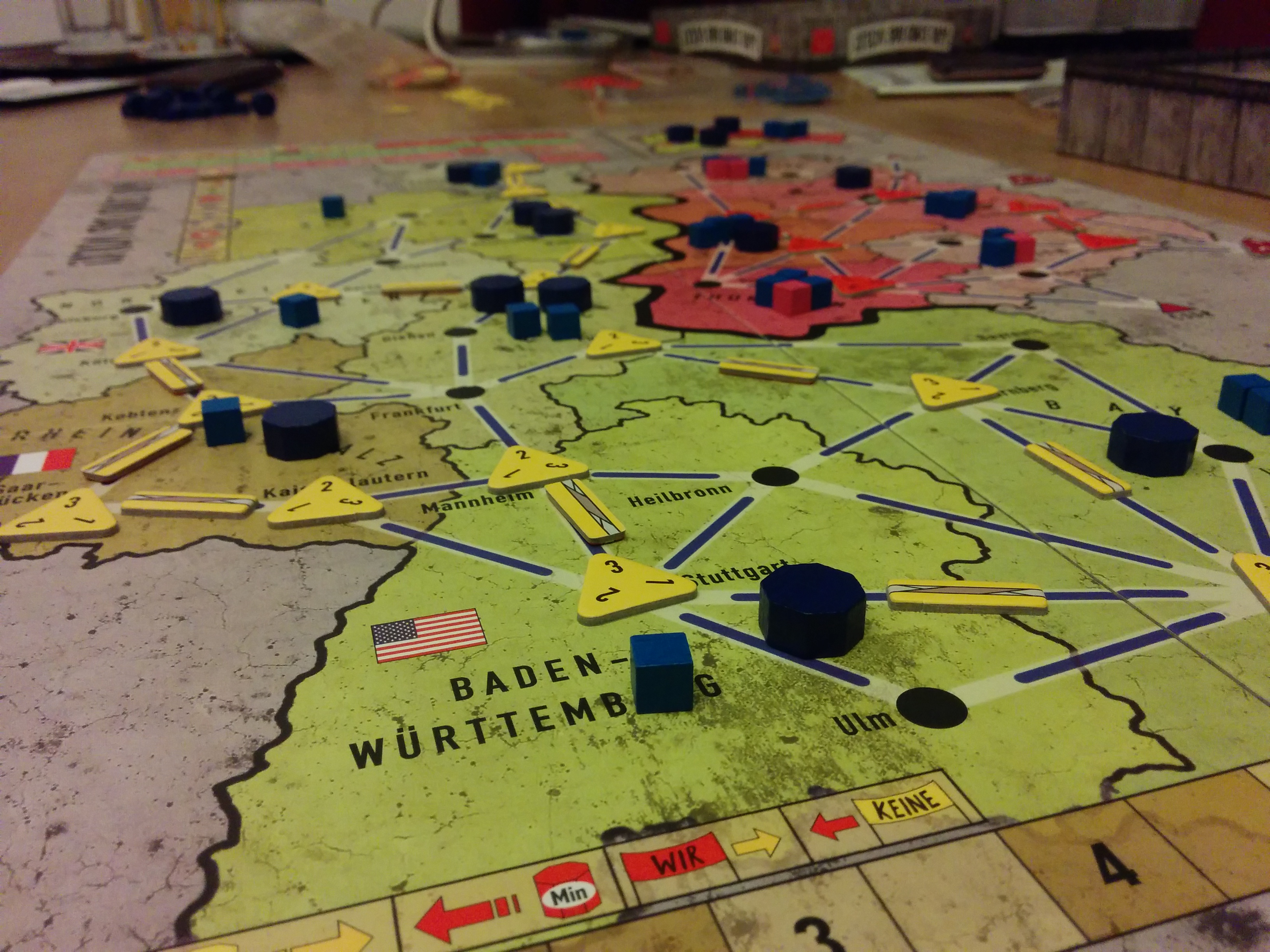
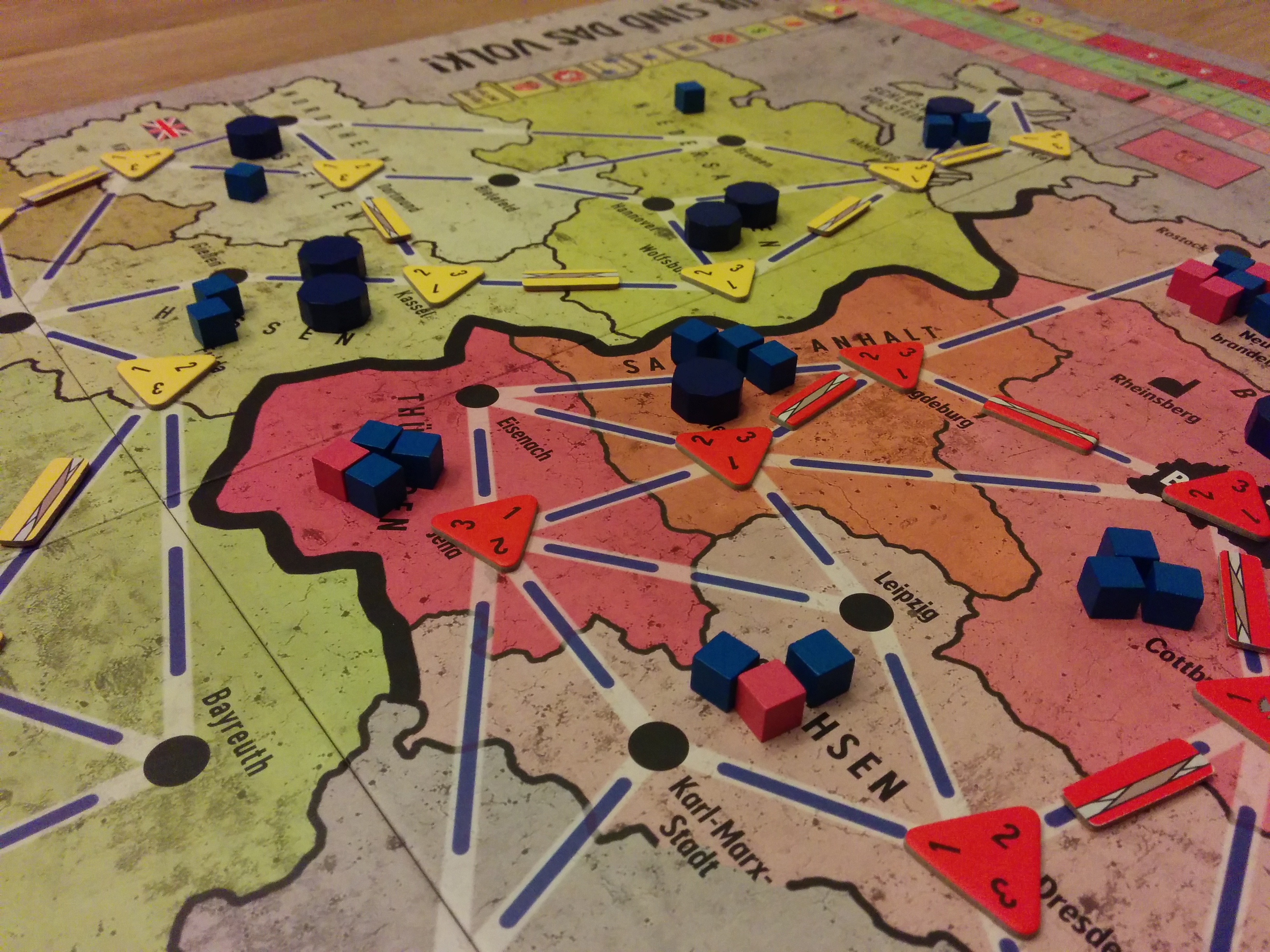
We played Wir sind das Volk! for the second time on Sunday as a learning round (this time two decades). I am still enthusiastic, Juliana is still a bit hesitant, but she likes it too. The second time went much better for the East, the economy there was struggling but functioning and sustainable for the two decades - whether it would have survived the next decade is rather doubtful, because Juliana was able to drastically boost the economy in the West and I couldn't keep a federal state at a low economic level this time. It's exciting when you see the board with all the economic connections and the clear difference between East and West becomes apparent - for example, in my case a socialist stronghold in Mecklenburg-Pomerania because mass unrest kept breaking out there, central economic concentrations in Brandenburg, Berlin, and Saxony. The West is definitely easier to play, as you can primarily focus on economic development there and only occasionally throw a spanner in the works (economically) with suitable events, while the East constantly has to fight against collapse and scrap together its economy from the strangest corners, fighting growing unrest in the population with ideology and suppression. We probably only made minor mistakes in the first decade with the republic flight (there, it is alternately decided which economy disappears), otherwise the two decades ran very smoothly - which speaks for a clear rule system. The decade-end phase also went more smoothly, even though this part really seems a bit fiddly - but since you go through a checklist there, you can hardly forget anything. However, it is a small lull in the flow of the game, especially because you go through the checklist according to the instructions at the beginning (there are practical graphic checklists on BGG, which are - if you know the whole thing quite well - probably much faster than going through the text).
What I considered worth reading during the week and did not want to link separately, collected here and uncommented.
- Delian League Diaries #1
- Janky Generals #1 – Latulla, Keldon Overseer
- Court ruling: E-Plus may not throttle data flat rate arbitrarily
- Deck Construction: Amarthiul, Lord of the Eagles
- Falling Sky Tactics: Roman Scout
- Belgian nuclear power plants: Too decrepit for cool cooling water
- State Development Plan presented: State Government wants to ban fracking in NRW
- COIN Series Falling Sky: Arverni Strategy
What I consider worth reading during the week and did not want to link separately, collected here and uncommented.
Hoplomachus: Origins has had me in its grip with its solo trials for a few days now. These are less of a full solo game and more like small scenarios with the challenge to break them - to find a solution by combining gladiators, tactics, and moves that can reliably defeat the scenario. Very quick to play and the AI for the opponents is surprisingly effective despite its very low complexity. It's quite fun and can be played quickly in between other things.
"We are the people!" came to the table for the first time with Juliana yesterday. As with my first solo round, however, only for the first decade, because that already shows all aspects of the game for the first learning, but does not immediately overwhelm you with the full program. With this game, I hope that Juliana's interest remains, because it is really very well made. It is essentially a mix of resource management with a bit of area control mixed in and - for the East - a good dose of State of Siege. Both sides play very differently, the West plays an economic development game with integrated attacks on the East with ideology and standard of living, the East is constantly fighting for survival and trying to put out all the fires, so in principle classic scarcity management. The West wins through the dissolution of the East, the East only has to survive until the end to win. From these very asymmetrical approaches and goals, a exciting tug-of-war between the two German states then results. The whole thing seasoned with a historical theme. Very cool.
zeromq/netmq: A 100% native C# implementation of ZeroMQ for .NET was completely unknown to me (the C# version, not ZeroMQ), but it is a really exciting project for .NET enthusiasts. Directly in .NET without external libraries or even servers, you can build various 1:1, 1:N, N:1, N:M communication structures with diverse behaviors (Pub/Sub, Broadcast, Req/Resp, Fifo - basically everything that ZeroMQ can do). It makes a very good impression (ok, no surprise, it is after all an implementation of the original ZeroMQ in C#, and ZeroMQ was absolutely brilliant for its purposes). And of course, it is interoperable with the original ZeroMQ.
What I considered worth reading during the week and did not want to link separately, collected and uncommented here.